
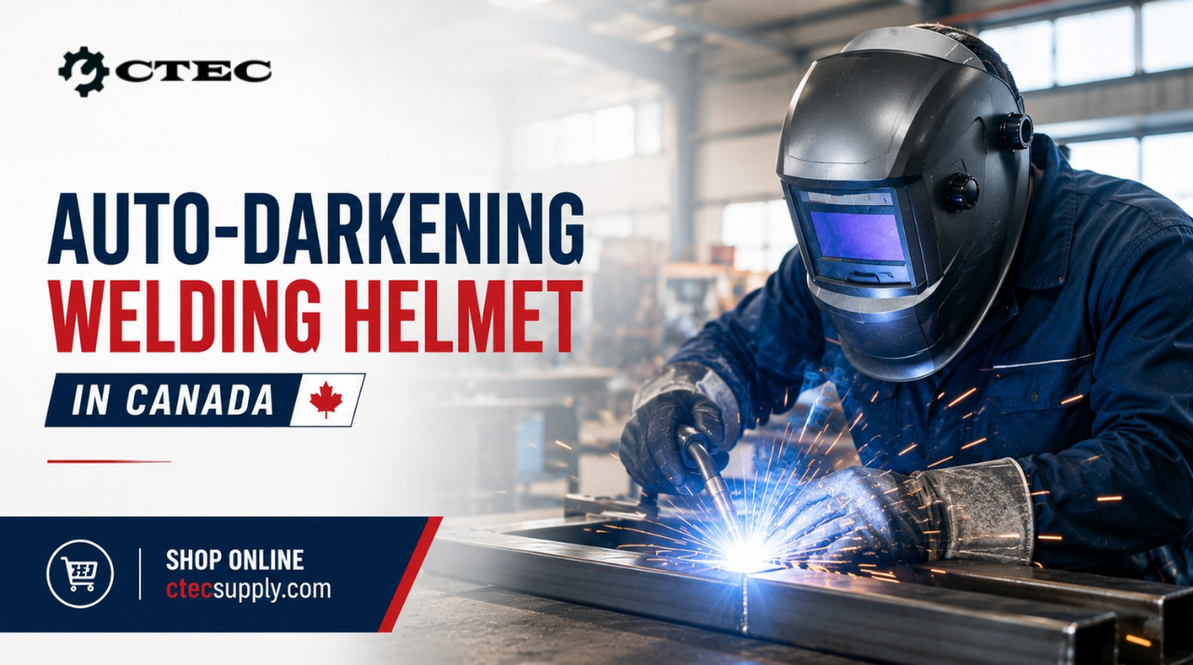
How to Choose an Auto-Darkening Welding Helmet in Canada
Welding Safety · Buying Guide · Canada
Shade numbers, the four-digit optical rating nobody explains, sensor count, switching speed and where CSA Z94.3 fits in. Everything you need to buy a helmet once and be happy with it.
The short answer
Judge an auto-darkening helmet on four things. Optical clarity, shown as a four-digit rating like 1/1/1/1, where lower is better on every digit. Shade range, fixed if you run one process, variable shade 9 to 13 if you switch. Sensor count, two for open bench work and four for out-of-position or pipe welding. Switching speed, where 1/25,000 of a second or faster is the standard to expect.
In Canada, confirm the helmet meets CSA Z94.3 and check your provincial regulator and employer policy. That is the compliance floor, not a nice-to-have.
What an auto-darkening filter is actually doing
An auto-darkening filter, or ADF, is a stack of liquid crystal layers and polarisers sandwiched between UV and infrared blocking coatings. In its resting state it sits at a light shade, usually around 3 or 4, which is dark enough to protect your eyes from ambient glare but light enough to see the joint and position your torch. Arc sensors on the front of the cartridge watch for the light signature of a striking arc. When they see it, a voltage is applied to the liquid crystal, the crystals reorient, and the lens darkens to the working shade.
One detail is worth internalising because it comes up in every safety meeting. The UV and infrared protection is permanent. It comes from the coatings on the glass, not from the electronics. A dead battery does not expose you to UV. What it does expose you to is the raw visible intensity of the arc, which is more than enough to cause painful photokeratitis, commonly called arc eye. So the electronics are not decoration. They are what stands between you and a very bad night.
The four-digit rating: what 1/1/1/1 means
Almost every quality ADF carries a code like 1/1/1/1 or 1/2/1/2. It comes from EN 379 and it is the most useful number on the box, yet it is the one most buyers skip. Each digit is a separate optical measurement, graded 1 to 3, and 1 is always the best.
| Digit | What it measures | What a poor score feels like |
|---|---|---|
| 1st · Optical class | Distortion across the lens | Straight lines look bent, eye strain over a shift |
| 2nd · Diffusion of light | Haze and scatter in the lens material | Milky, low contrast view of the puddle |
| 3rd · Luminous transmittance variation | Whether shade is even across the whole lens | Darker in one corner, lighter in another |
| 4th · Angle dependence | Shade consistency when viewed off centre | Shade shifts when you tilt your head, worst on pipe work |
If you weld occasionally, a 1/2/1/2 lens is perfectly serviceable. If you are under the hood most of the day, the difference between 1/1/1/1 and a lower-rated lens shows up as fatigue by mid-afternoon, and that is worth paying for.
Picking the right shade
The shade number describes how much light the filter blocks. Higher means darker. The guidance below reflects the shade selection tables used widely in North America, including the guidance referenced by CSA Z94.3. Treat the listed number as a starting point and check your helmet manufacturer's chart for the specific process and amperage.
| Process | Arc current | Typical working shade |
|---|---|---|
| Stick (SMAW) | 60 to 160 A | 10 to 11 |
| Stick (SMAW) | 160 to 250 A | 11 to 12 |
| MIG (GMAW) | 60 to 160 A | 10 to 11 |
| MIG (GMAW) | 160 to 250 A | 11 to 12 |
| TIG (GTAW) | Under 50 A | 8 to 10 |
| TIG (GTAW) | 50 to 150 A | 10 to 12 |
| Plasma cutting | Light to medium | 9 to 12 |
| Air carbon arc gouging | High current | 12 to 14 |
A practical method used by a lot of instructors: start at a shade that is clearly too dark to see detail, then step lighter one number at a time until you can see the weld zone clearly. Stop there and do not go lighter. The listed shade is a minimum for protection, so going darker than the chart is fine as long as you can still see what you are doing.
Kitting out a shop or a welding program?
CTEC Supply stocks auto-darkening helmets, replacement lenses, jackets, gloves and welding PPE. Ask about pricing on multi-unit orders shipped from your nearest Canadian warehouse.
Call 855-960-7369 Request a QuoteFixed shade or variable shade
A fixed shade helmet darkens to one preset value, usually shade 10. It is simpler, generally cheaper, and there is one less thing to set wrong. If you run the same process at roughly the same amperage every day, a good fixed shade 10 helmet is a completely defensible purchase, and often a better lens for the money than a cheap variable one.
A variable shade helmet adjusts across a range, commonly 9 to 13. That flexibility earns its keep the moment your work varies. Low amp TIG on thin stainless wants a lighter shade than heavy stick on structural steel, and switching a dial beats owning two helmets. Most production shops end up here.
Two related controls are worth understanding. Sensitivity sets how much arc light is needed to trigger the filter, which matters for low amperage TIG where the arc is dim, and for working next to other welders whose arcs can trigger your lens. Delay controls how long the lens stays dark after the arc stops. Short delay for tacking, longer delay on heavy amperage so the glowing puddle does not flash you as the lens clears.
Sensors and switching speed
Arc sensors are the small windows on the face of the cartridge. Two sensors are fine for flat, open bench work where nothing is between the arc and the helmet. Four sensors are the sensible default for anything out of position, inside a joint, behind a flange or on pipe, because the workpiece or your own hand can shadow one or two sensors and a missed trigger means a flash.
Switching speed is how fast the lens goes from light to dark, quoted as a fraction of a second. Quality helmets sit around 1/25,000 to 1/30,000 of a second at room temperature. That is far quicker than your eye can perceive, so the practical question is not whether faster is visible but whether the number is honest and whether the helmet maintains that speed in cold conditions. Many manufacturers publish a slower figure at low temperature, which is genuinely relevant for anyone welding outdoors in a Canadian winter.
Power, weight and the parts you will replace
Most ADFs use a solar cell to top up an internal or replaceable lithium battery. The three arrangements you will see:
- Replaceable battery plus solar. The most practical for a working shop. When the cell dies, you change it in the field for a few dollars.
- Sealed internal battery plus solar. Cleaner and often lighter, but when the cell reaches end of life the cartridge is finished.
- Battery only with an on/off switch. Reliable, but you will eventually leave it on in the truck.
Weight matters more than buyers expect. A helmet that is 100 grams heavier does not feel different in the store and feels very different at hour six, particularly overhead. So does headgear quality. A ratchet suspension with a wide crown strap and independent tilt adjustment is the difference between a helmet that stays put and one that slides every time you nod.
Budget for consumables from day one. Outside cover lenses are sacrificial and should be replaced as soon as they pick up enough spatter to blur the view. Inside cover lenses scratch too. Sweatbands wear out. A helmet with cheap and widely available cover lenses will cost you less over three years than a slightly better helmet with proprietary parts nobody stocks.
CSA Z94.3 and what it means for a Canadian shop
In Canada, eye and face protection is governed by CSA Z94.3, Eye and Face Protectors, with CSA Z94.3.1 providing guidance on selection, use and care. Provincial and territorial occupational health and safety regulations typically require employers to provide protection that meets the standard, so a helmet marked to CSA Z94.3 is the baseline for workplace use.
Two practical implications. First, if you are buying for a crew, verify the marking rather than assuming, because a helmet sold for hobby use may not carry it. Second, the helmet is only part of the picture. Welding still requires safety glasses underneath for when the hood is up, plus flame resistant clothing, gloves and respiratory protection matched to the process and the base metal. Requirements vary by jurisdiction and by job, so confirm against your own provincial regulator and your employer's program.
Quick picks by welder type
| You are | Look for | Skip |
|---|---|---|
| Occasional MIG at home | Fixed shade 10, 2 sensors, decent optics | Wide variable range you will never use |
| General fab shop | Variable 9 to 13, 4 sensors, 1/1/1/1, grind mode | Sealed batteries you cannot replace |
| Low amp TIG and thin stainless | Verified low amp rating, high sensitivity, 1/1/1/1 | Entry cartridges that miss the arc under 20 A |
| Pipe and out of position | 4 sensors, low angle dependence, light weight | 2 sensor helmets, heavy shells |
| Outdoor winter work | Published low temperature operating range | Anything with no stated cold rating |
Browse current stock in Welding Helmets, plus Welding PPE, Magnetic Welding Holders and Flap Discs for the cleanup afterwards.
Frequently asked questions
What does the 1/1/1/1 rating mean?
It is the EN 379 optical clarity rating covering optical class, diffusion of light, transmittance variation and angle dependence. Each is scored 1 to 3 with 1 being best, so 1/1/1/1 is the highest rating available.
What shade should I use for MIG welding?
Around 60 to 160 amps, shade 10 is a common minimum with 11 often more comfortable. Go darker as amperage rises, and confirm against CSA Z94.3 guidance and your manufacturer's chart.
Fixed shade or variable shade?
Fixed shade if you run one process at consistent amperage. Variable shade 9 to 13 if you move between MIG, TIG, stick and plasma cutting.
How many arc sensors do I need?
Two for open bench work. Four for out-of-position, pipe or anywhere the arc can be shadowed by the workpiece or your hand.
Does the helmet protect me if the battery dies?
The UV and infrared coatings are permanent and always active, but the lens will not darken. You would be exposed to the full visible intensity of the arc, so never weld with a filter that is not switching properly.
Which standard applies in Canada?
CSA Z94.3 for eye and face protectors, with CSA Z94.3.1 covering selection, use and care. Provincial and territorial regulations generally reference it, so check your own jurisdiction and employer policy.
Need help choosing a helmet for your crew?
Tell us the processes you run, the amperage range and how many welders you are outfitting. We will put together options and pricing.
Call 855-960-7369 Contact CTEC Supply Shop Welding HelmetsShipping Canada-wide from Vancouver, Edmonton, Winnipeg, Toronto, Laval and Halifax.
Recent Posts
-
How to Choose an Auto-Darkening Welding Helmet in Canada
Welding Safety · Buying Guide · Canada Shade numbers, the four-digit optical rating nobody expla …20th Aug 2026 -
How to Choose the Right Power Tool for Your Project
A Practical Buying Guide for Homeowners, DIY Enthusiasts, and Professionals Choosing a power tool is …10th Aug 2026 -

The Beginner’s Guide to the Power Drill: Your Ultimate Essential Tool
The power drill. It seems so simple, doesn't it? Nearly everyone has one-whether it’s a pro-grade be …6th May 2026