
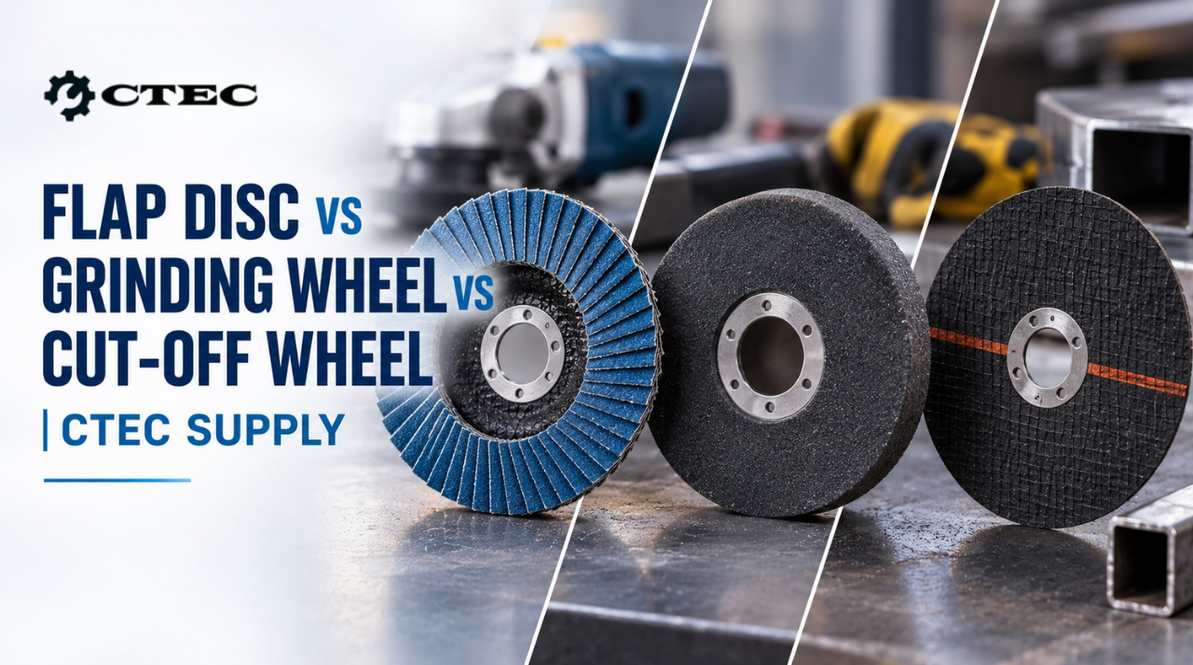
Flap Disc vs Grinding Wheel vs Cut-Off Wheel: Which One Should Actually Be on Your Grinder?
Abrasives · Buying Guide · Canada
Three discs, one 4.5 inch grinder, and a shop full of opinions. Here is how to sort out which abrasive belongs on which job, how to read the markings on the label, and what a Canadian fabrication shop should keep on the shelf.
The short answer
A cut-off wheel severs material. It is thin, usually 0.045 inch to 1/8 inch, and it works with the edge of the wheel only. A grinding wheel removes heavy metal fast. It is thick, usually 1/4 inch, and it works with the face at roughly a 30 degree angle. A flap disc grinds and finishes in the same pass. It is a stack of overlapping abrasive cloth flaps that wears back to expose fresh grain, so it leaves a far better surface than a bonded wheel.
If you only stock one thing for weld cleanup and general fabrication, make it a 60 grit zirconia flap disc. If you only stock one thing for cutting, make it a 0.045 inch reinforced cut-off wheel.
Why the wrong disc costs more than the right one
Every shop has that drawer. A dozen half-used discs, three brands, no labels left on any of them, and someone reaching in blind before a shift. It feels thrifty. It is not.
A grinding wheel used to blend a weld leaves gouges that a painter or a QC inspector will send straight back to you. A flap disc used to cut leaves a shower of shed flaps and a wheel that is done in ninety seconds. A cut-off wheel used to grind is the genuinely dangerous one, because the moment you put side pressure on a thin bonded wheel it can fracture.
None of that shows up on a purchase order. It shows up as rework hours, as a scrapped part, or as an incident report. Abrasives are one of the few consumables where picking correctly pays for itself inside a single shift.
What each abrasive is actually built to do
Cut-off wheels: for severing, nothing else
A cut-off wheel is a thin bonded abrasive disc reinforced with fibreglass mesh, designed to be loaded on its edge and nowhere else. Thickness drives the behaviour. A 0.045 inch wheel cuts fast with a narrow kerf and very little heat build-up, which matters on stainless and on thin wall tube where discolouration is a defect. A 1/8 inch wheel is slower and burns more material, but it survives rough handling on a demolition or scrap job.
Two habits separate people who get a full life out of a cut-off wheel from people who snap them. First, let the wheel do the cutting instead of leaning on it. Second, keep the cut straight. Twisting the grinder to follow a curve is the single most common cause of wheel breakage.
Grinding wheels: for heavy stock removal
A depressed centre grinding wheel, usually Type 27 and 1/4 inch thick, is the tool for taking metal off in a hurry. Removing a tack, knocking back a badly overbuilt fillet, prepping a bevel, cleaning a mill scale edge before welding. Nothing removes steel faster per dollar.
The trade-off is surface finish. A bonded wheel leaves deep, directional scratches and it can burn the surface if you park it in one spot. On carbon steel that is often fine because the next step is paint or another weld pass. On visible or corrosion-critical work, it means a second operation.
Flap discs: the one-step compromise that usually wins
A flap disc is made of overlapping cloth abrasive flaps bonded to a fibreglass or plastic backing plate. As the leading edge of each flap wears, it breaks away and exposes fresh grain behind it. That self-sharpening action is why a flap disc keeps cutting at a consistent rate through its life instead of glazing over.
In practice a 40 or 60 grit flap disc removes weld metal at a rate close to a grinding wheel while leaving a surface you can paint or inspect without a follow-up step. That is the whole argument. You pay more per disc and you get back the time you were spending on a second pass.
Flap discs come in two shapes. Type 27 is flat, best for blending and finishing at a shallow 5 to 15 degree angle. Type 29 is conical, best for aggressive removal at 15 to 25 degrees and for getting into corners.
Side by side comparison
| Factor | Cut-off wheel | Grinding wheel | Flap disc |
|---|---|---|---|
| Primary job | Severing material | Heavy stock removal | Grind and blend in one step |
| Typical thickness | 0.045 in to 1/8 in | 1/4 in | Flap stack, no fixed thickness |
| Working angle | 90 degrees, edge only | 25 to 35 degrees | 5 to 25 degrees |
| Surface left behind | Cut face, needs deburring | Coarse, directional gouges | Paint ready at 60 to 80 grit |
| Side loading | Never | Designed for it | Designed for it |
| Cost per unit | Lowest | Low | Highest |
| Cost per finished part | Not comparable | Higher once you add a finishing pass | Usually the lowest |
Buying abrasives by the case?
Shops running multiple grinders go through discs faster than they think. Talk to CTEC Supply about volume pricing and standing orders shipped from the warehouse closest to you.
Call 855-960-7369 Request a Bulk QuoteChoosing grit without guessing
Grit is the size of the abrasive grain. Lower numbers mean bigger grains, faster removal and a rougher finish. The mistake most crews make is starting too fine, fighting the disc, and burning through two of them where one coarse disc would have done the work.
| Grit | Use it for | Finish you get |
|---|---|---|
| 36 to 40 | Heavy weld removal, casting flash, rust and scale | Rough, needs a follow-up |
| 60 | The workhorse. Weld blending, edge breaking, general fab | Paint ready on structural steel |
| 80 | Blending on visible work, prepping stainless | Uniform, low scratch depth |
| 120 and finer | Pre-polish, architectural stainless, food grade equipment | Near satin |
Match the grain to the metal
Grain type matters as much as grit, and it is the thing most people ignore because the label is covered in marketing language.
- Aluminum oxide is the budget option. Fine for mild steel, occasional use, general shop maintenance. It dulls quickly under pressure.
- Zirconia alumina is the default for production fabrication. The grain fractures under heat and pressure to create new cutting edges, so it holds its rate through a long grind. This is what most shops should be buying for carbon steel and stainless.
- Ceramic costs the most and lasts the longest on hard alloys, stainless and high-pressure applications. It needs firm pressure to work properly, so it is a poor fit for light touch-up work.
- Silicon carbide is for non-ferrous and non-metallic work. Aluminum, brass, stone and concrete.
One point specific to stainless steel: use a disc marked contaminant free, meaning iron, sulphur and chlorine each under 0.1 percent. A standard disc will embed free iron into the surface and you will find rust blooms weeks later on a part that was supposed to be corrosion resistant. On aluminum, look for a disc with a grinding aid or an open coat, otherwise the soft metal loads the abrasive within seconds.
The safety numbers that are not optional
Every bonded abrasive disc carries a maximum operating speed printed on the label or the metal ring. That number has to be equal to or greater than the no-load speed of your grinder. A 4.5 inch disc is generally rated around 13,300 RPM, a 7 inch disc around 8,500 RPM. Fitting a 7 inch disc to a 4.5 inch grinder is the classic way to detonate a wheel, because the small grinder spins far faster than the big disc can survive.
Bonded wheels also expire. The resin bond takes on moisture and degrades, so wheels carry an expiry date, generally three years from manufacture. That is worth a monthly walk through the consumables cabinet, especially in humid coastal shops in BC and Nova Scotia.
The rest is familiar but still worth writing on the wall: guard stays on, face shield over safety glasses, ring test any wheel you are unsure about, and run a new wheel for thirty seconds with nobody standing in the plane of rotation before you touch it to metal.
What to keep on the shelf
For a two to five person fabrication or maintenance shop running 4.5 inch grinders, this covers most of a year without overstocking:
- 0.045 inch cut-off wheels, by the box. These go fastest.
- 60 grit zirconia Type 29 flap discs as the everyday disc.
- 40 grit for the heavy days and 80 grit for finish work.
- A small stock of 1/4 inch Type 27 grinding wheels for bevel prep and tack removal.
- A separate, clearly marked set of contaminant free discs if you touch stainless at all.
- Surface conditioning discs for finish blending, plus wire cup brushes for scale and paint.
Browse the full range in Abrasives, or jump straight to Flap Discs, Cut-Off and Grinding Wheels and Surface Conditioning Discs. If you are replacing the grinder as well, the Grinders category is the place to start.
Frequently asked questions
Can you cut with a flap disc?
No. A flap disc has no reinforcement built to handle the side loading of a cut. It will shed flaps almost immediately and give you a ragged, wandering cut. Use a thin cut-off wheel.
What grit flap disc should I use on stainless steel?
Start at 60 grit to bring the weld down, then finish with 80 or 120. Use a contaminant free zirconia or ceramic disc so you do not embed free iron into the surface.
Do grinding and cut-off wheels expire?
Yes. Bonded abrasive wheels carry an expiry date, generally three years from manufacture, because the resin bond degrades with age and humidity. Pull expired wheels out of service.
What RPM rating do I need for a 4.5 inch disc?
At least 13,300 RPM for most 4.5 inch grinders. The disc's rated maximum speed must meet or exceed the grinder's no-load speed. Check both numbers before every change.
Is a flap disc worth the extra cost?
In most fabrication work, yes. It removes a separate finishing step, wears evenly instead of leaving a stub, and holds a steady cut rate. On pure heavy removal with no finish requirement, a grinding wheel is still cheaper.
Does CTEC Supply ship abrasives across Canada?
Yes. Orders ship Canada-wide from warehouses in Vancouver BC, Edmonton AB, Winnipeg MB, Toronto ON, Laval QC and Halifax NS. Call 855-960-7369 for bulk and contract pricing.
Not sure which disc suits your job?
Tell us the material, the grinder and the finish you need. Our team will spec the right abrasive and get it moving from the closest Canadian warehouse.
Call 855-960-7369 Contact CTEC Supply Shop AbrasivesShipping Canada-wide from Vancouver, Edmonton, Winnipeg, Toronto, Laval and Halifax.
Recent Posts
-
Flap Disc vs Grinding Wheel vs Cut-Off Wheel: Which One Should Actually Be on Your Grinder?
Abrasives · Buying Guide · Canada Three discs, one 4.5 inch grinder, and a shop full of opinions. …4th Sep 2026 -
How to Choose an Auto-Darkening Welding Helmet in Canada
Welding Safety · Buying Guide · Canada Shade numbers, the four-digit optical rating nobody expla …20th Aug 2026 -
How to Choose the Right Power Tool for Your Project
A Practical Buying Guide for Homeowners, DIY Enthusiasts, and Professionals Choosing a power tool is …10th Aug 2026