
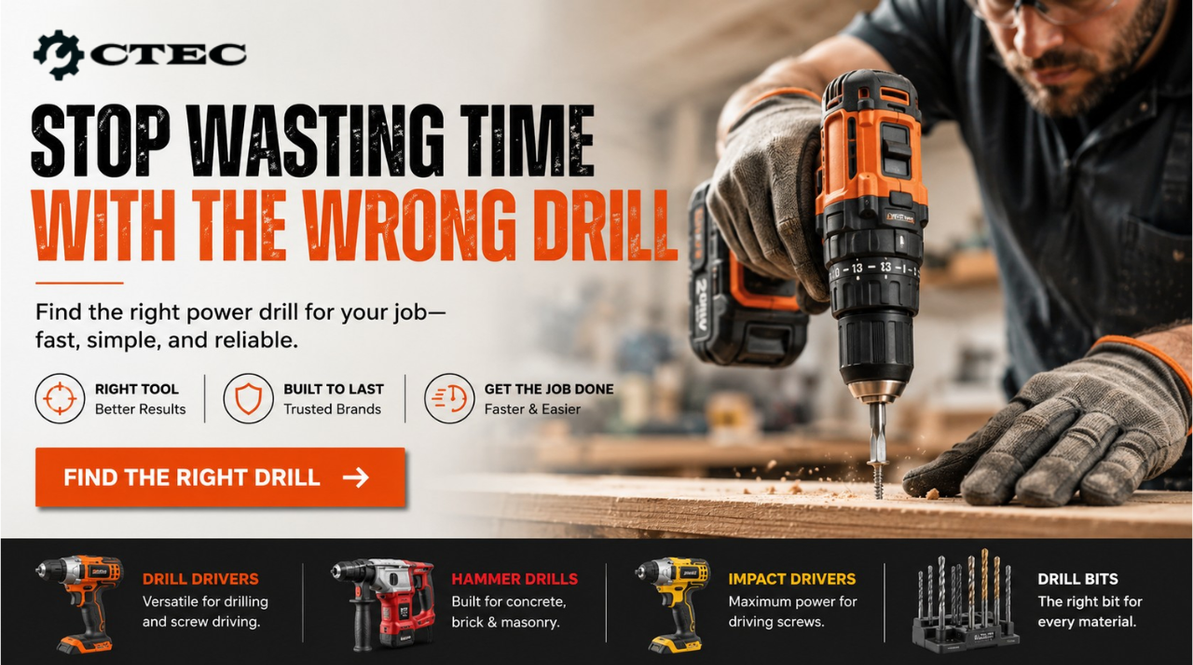
The Beginner’s Guide to the Power Drill: Your Ultimate Essential Tool
The power drill. It seems so simple, doesn't it? Nearly everyone has one-whether it’s a pro-grade beast in a workshop or stashed in a homeowner’s "emergency repair kit" next to a dusty hot glue gun and some multi-use pliers.
Regardless of your skill level, we should all get on the same page: the power drill is extremely useful. But don't get it twisted; it isn't just a gadget for putting together IKEA furniture. It is a versatile powerhouse capable of quickly driving screws and boring clean holes through almost anything.
Versatility Across Materials
One of the best things about a power drill is its range. You can use it on a variety of materials, including:
- Wood and Plastic
- Metal and Concrete
- Glass and Ceramic
The secret isn't just the drill itself, but the bits. There are thousands of types and sizes of bits out there. While you can't use the same bit for every material, there is almost certainly a specialized bit designed for whatever project you have in mind.
How Does the Bit Stay in Place?
If you’re new to tools, you might wonder how that spinning piece of metal stays put. The bit is held at the end of the drill shaft by a clamping device called a chuck.
There are two main types of chucks you'll encounter:
- Keyless Chucks: The most common for DIYers. You simply insert the bit and hand-tighten the clamp. It’s fast and convenient.
- Keyed Chucks: These require a "chuck key" (a small metal tool) to tighten the clamp. While less convenient, they provide a much more secure grip, minimizing the chance of the bit slipping during heavy-duty tasks.
The Need for Speed
Much like a car, drills come with different speed settings. You’ll generally find two types:
- Fixed Speed: The drill has set speeds you toggle between.
- Variable Speed: This is the gold standard. The drill goes faster or slower depending on how hard you squeeze the trigger.
Having variable speed is vital for accuracy. For example, you want to start a hole slowly so the bit doesn't "walk" across the wood, then speed up once the hole is established.
Corded vs. Cordless: Which is Better?
The most obvious difference here is mobility, but the choice goes deeper than just the cord.
|
Feature |
Cordless Drills |
Corded Drills |
|
Mobility |
Total freedom; move anywhere. |
Limited by cord length/extension cords. |
|
Power |
Dependent on battery life. |
Continuous, steady power supply. |
|
Strength |
Great for most tasks; modern ones are very strong. |
Generally offer higher torque and RPMs for heavy-duty work. |
|
Weight |
Heavier (due to the battery). |
Lighter in the hand (no battery pack). |
Before purchasing, think about your projects. If you're working on a roof or a fence, go cordless. If you’re at a workbench doing heavy boring all day, corded might be your best friend.
Understanding the Different Types of Drills
Not all drills are created equal. Depending on the job, you might need a specific "flavor" of drill:
- Drill Drivers: The jack-of-all-trades. Engineered for both drilling holes and driving screws.
- Hammer Drills: These are heavy-duty tools that use a "hammering" action to pulverize masonry, allowing you to drill into concrete or brick.
- Impact Drivers: Primarily used for driving screws. They use a "tapping" motion that allows them to powerfully drive long screws into dense materials without stripping the screw head.
Ready to Start Your Collection?
There you have it-the basics of the power drill. Trust us, we could go on forever, but this should be enough to get you started!
Looking for the perfect drill? Check out the selection at CTEC Supply. We offer a massive variety of models from JET at the best prices.
Thanks for stopping by, and we’ll catch you in the next post!
Recent Posts
-
Flap Disc vs Grinding Wheel vs Cut-Off Wheel: Which One Should Actually Be on Your Grinder?
Abrasives · Buying Guide · Canada Three discs, one 4.5 inch grinder, and a shop full of opinions. …4th Sep 2026 -

How to Choose an Auto-Darkening Welding Helmet in Canada
Welding Safety · Buying Guide · Canada Shade numbers, the four-digit optical rating nobody expla …20th Aug 2026 -
How to Choose the Right Power Tool for Your Project
A Practical Buying Guide for Homeowners, DIY Enthusiasts, and Professionals Choosing a power tool is …10th Aug 2026